The problem
Turning a PRD into working scaffolding is repetitive engineering toil that delays the interesting part of building a feature.
How it works
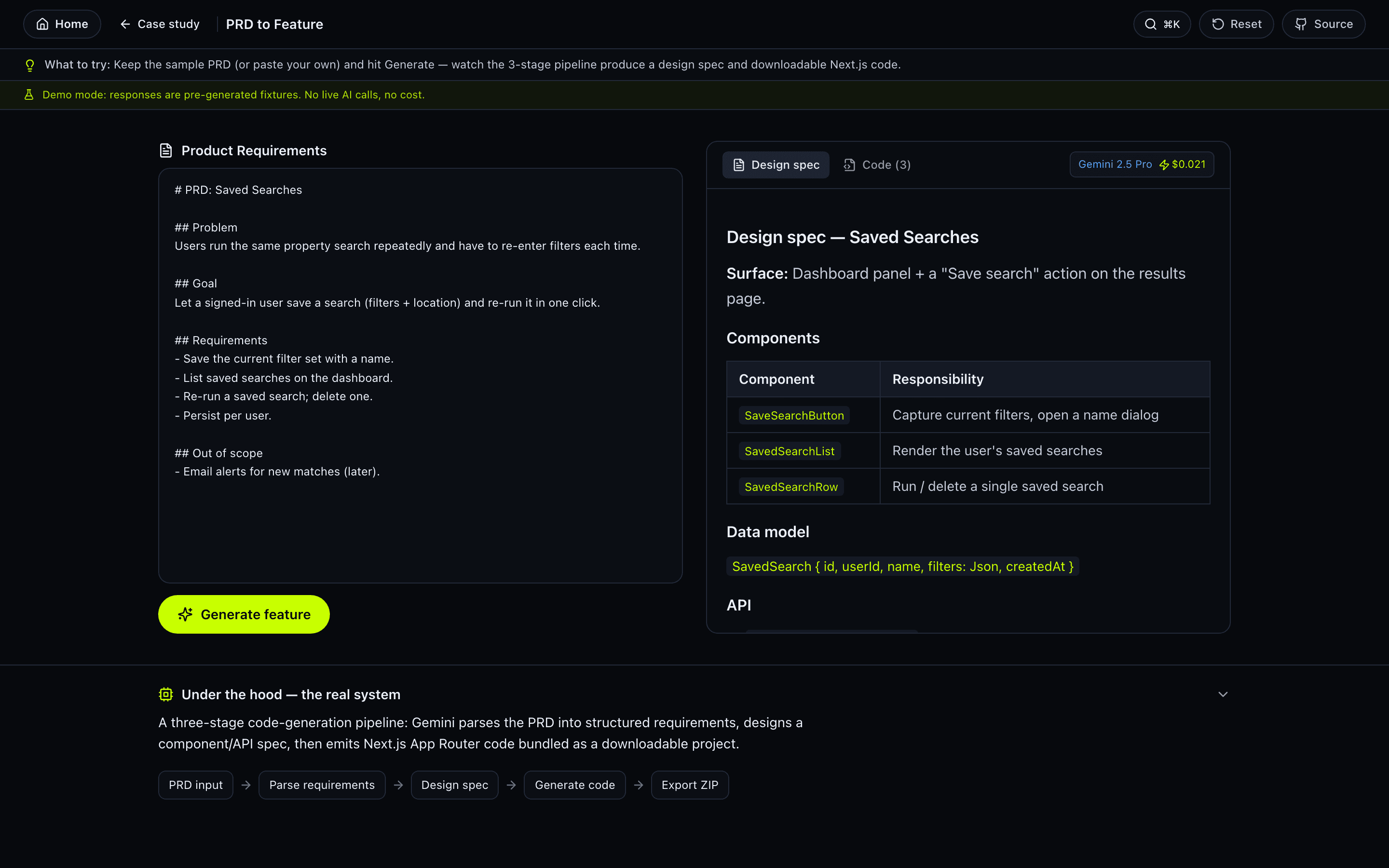
Gemini runs in three passes. First it extracts structured requirements from the document. Then it proposes a design spec and component tree. Finally it emits Next.js App Router code, which is zipped for download.
Highlights
- Three-stage pipeline: parse the PRD, generate a design spec with a component breakdown, then generate App Router UI and API code.
- Full project export: generated code is bundled into a downloadable ZIP ready to drop into a Next.js project.
- Accepts PRD upload (.md / .txt) or direct paste.
- Playwright suite validates the generation pipeline end to end.
Key decisions & tradeoffs
Three discrete passes (parse → spec → code), not one mega-prompt.
Each step is inspectable and correctable; a single prompt that does everything is a black box that's hard to debug or improve.
Generate a design spec before any code.
Forcing an explicit plan first yields far more coherent output than asking for code directly — the same reason humans design before building.
Ship a runnable project ZIP, not a code snippet.
A copy-paste snippet stalls at integration; a drop-in Next.js project is the difference between a demo and something a team actually uses.